

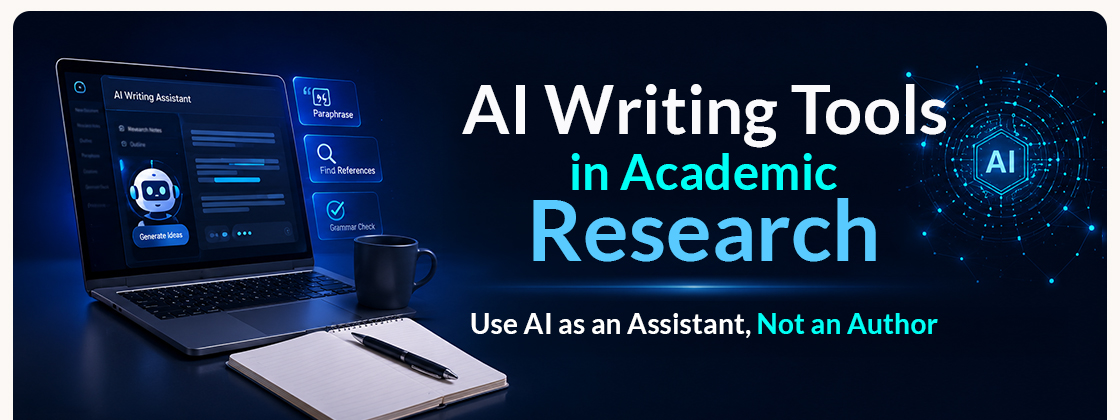
How to Use AI Writing Tools Effectively for Academic Writing


Academic and professional writing is going through a quiet transformation. Over the past few years, researchers, students, and faculty members have started turning to AI Writing Tools to help draft manuscripts, polish language, and organise complex ideas. This shift is not surprising. Writing a research paper takes time, and much of that time goes into tasks that have little to do with the actual discovery or argument being made.
At the same time, this growing reliance on AI raises real questions. Can these tools be trusted with academic content? Where do they help, and where might they introduce errors or ethical problems? This blog looks at both sides of the conversation. It explains what AI Writing Tools actually do, where they genuinely help researchers, what risks come with careless use, and how scholars can use them responsibly without compromising the integrity of their work.
What Are AI Writing Tools?
AI Writing Tools are software applications that use language models to help people write, edit, or organise text. At a basic level, they work by analysing patterns in large amounts of text and using those patterns to predict and generate new sentences, suggest edits, or restructure existing content.
It helps to separate two different uses of these tools. The first is writing assistance: grammar correction, sentence rephrasing, structural suggestions, and language polishing. The second is content generation: producing entire paragraphs or sections from a prompt with little human input. Most academic use cases fall into the first category. A researcher might use an AI tool to tighten a wordy paragraph, check for consistent tense usage, or generate a first pass at a literature summary that they then revise themselves. Full content generation, in which AI produces publishable text with no meaningful human authorship, is far more controversial and is treated with caution by most journals and institutions.
Common academic use cases include improving readability for non-native English speakers, converting rough notes into structured drafts, summarising long papers, and checking grammar before submission. None of these uses replaces the researcher's own analysis or conclusions; they simply reduce the mechanical effort involved in producing a clean, readable draft.
Benefits of Using AI Writing Tools
When used thoughtfully, AI Writing Tools offer several practical advantages for people working on manuscripts, dissertations, and reports.
Faster drafting. Staring at a blank page is one of the biggest barriers to writing. AI content writing tools can generate a rough starting point that researchers can then reshape and refine, reducing the time it takes to move from idea to first draft.
Grammar and language improvement. For many researchers, especially those writing in a second language, grammar and phrasing can be a persistent obstacle. AI writing assistants catch awkward phrasing, subject-verb agreement issues, and inconsistent terminology far faster than manual proofreading alone.
Better organisation of ideas. Research findings are often complex, with multiple variables, comparisons, and caveats. AI tools for researchers can help restructure dense information into a logical flow, making it easier for readers to follow the argument.
Assistance with summaries. Reviewing dozens of papers for a literature review is time-consuming. AI tools can produce quick summaries of individual papers, which researchers can then verify and use as a starting point for deeper analysis.
Support for non-native English writers. Academic publishing is dominated by English-language journals, which creates a disadvantage for many capable researchers. AI writing support helps level this playing field by improving clarity without changing the underlying ideas.
Improved productivity during manuscript preparation. From formatting reference lists to adjusting tone for a specific journal's style, AI tools for content creation can handle repetitive tasks, freeing up researchers to focus on the substance of their work.
Risks and Limitations
Despite these benefits, AI Writing Tools come with limitations that researchers cannot afford to overlook.
One of the most serious risks is fabricated or incorrect information. Language models generate text based on patterns rather than verified facts, which means they can produce statements that sound convincing but are simply wrong. This is especially dangerous in academic writing, where accuracy is non-negotiable.
Closely related is the problem of inaccurate citations and references. AI tools have been known to generate citations for papers that do not exist, or to misattribute findings to the wrong authors. Relying on these without independent verification can quickly damage a researcher's credibility.
There is also the question of originality. AI-generated content is built on patterns found in existing text, raising concerns about how original the output truly is. Academic writing depends on original analysis and voice, so leaning too heavily on generated text can blur the line between a researcher's own contribution and machine-produced filler.
Ethical concerns extend beyond originality. Some journals have strict rules regarding the disclosure of AI use, and failing to follow these guidelines can be treated as misconduct. Bias is another factor: because these models learn from existing text, they can reproduce the same biases present in their training data, which may subtly influence tone, framing, or emphasis in ways the writer does not intend.
Privacy and confidentiality also deserve attention. Pasting unpublished data, sensitive findings, or proprietary content into a public AI tool can expose that information in ways researchers may not anticipate. Finally, every suggestion an AI tool produces needs to be checked. Treating AI output as a finished product rather than a draft is where most of the trouble begins.
Best Practices for Responsible AI Use
Given these risks, a few practical habits can help researchers use AI responsibly.
Use AI as a writing assistant rather than an author. It should support the process, not replace the researcher's own reasoning or conclusions. Always fact-check generated information before including it in a manuscript, no matter how confident the output sounds. Verify references independently by checking that the cited paper exists and actually says what the AI claims it says.
It also helps to rewrite AI-generated text in your own voice. This keeps the writing consistent with the researcher's own style and ensures genuine engagement with the material rather than passive acceptance of machine output. Following journal and institutional guidelines is equally important, since AI disclosure policies vary widely and are changing quickly as publishers catch up with the technology.
Maintaining academic integrity should remain the guiding principle behind every decision about how much AI assistance to use. And before submission, human editing should always have the final say. A colleague, mentor, or editor reviewing the manuscript adds a layer of judgment that no tool can fully replicate. Used this way, AI can offer genuine author publication support without compromising the quality or credibility of the work.
The Future of AI Writing
The future of AI writing will likely bring more specialised tools tailored to academic contexts, with better citation checking, discipline-specific language models, and tighter integration with reference managers and plagiarism checkers. As these tools mature, they may become as routine in a researcher's workflow as spell check is today.
Even so, human expertise will remain central to research writing. Critical thinking, original analysis, and ethical judgment are not things a model can provide. AI-generated content can support the process, but the responsibility for accuracy, originality, and integrity will continue to rest with the researcher. The tools will keep improving, but the standards for good scholarship are unlikely to change.
AI Writing Tools offer real, practical benefits for researchers: faster drafting, cleaner language, better organisation, and meaningful support for non-native English speakers. At the same time, they carry risks that cannot be ignored, from fabricated information to questions of originality and ethics. The right approach is neither to reject these tools outright nor to rely on them blindly. Used as an assistant rather than an author, with careful fact-checking and human review at every stage, AI can genuinely improve efficiency in academic writing while preserving the quality and integrity of scholarly work.
FAQ Section
1. What are AI Writing Tools?
AI Writing Tools are software applications that use language models to assist with writing tasks such as grammar correction, rephrasing, summarisation, and structuring content. They range from simple grammar checkers to more advanced tools capable of generating draft text.
2. Can AI writing tools be used for academic research papers?
Yes, but with caution. They work well for tasks like language editing, summarising sources, or organising ideas. However, the core analysis, argument, and conclusions should remain the researcher's own work.
3. Are journals allowing AI-generated content?
Policies vary by publisher and journal. Many now require authors to disclose any AI assistance used during manuscript preparation, and some restrict the inclusion of AI-generated text without significant human revision. Authors should always check the specific guidelines of the journal they are submitting to.
4. How can researchers use AI responsibly?
By treating AI as a writing assistant rather than an author, fact-checking all generated content, verifying citations independently, disclosing AI use where required, and having a human review the final manuscript before submission.
5. Can AI replace human academic writing?
No. AI can support drafting and editing, but it cannot replace the critical thinking, original analysis, and subject expertise that researchers bring to their work.
6. What should authors verify before submitting AI-assisted manuscripts?
Authors should verify the accuracy of any facts or data mentioned, confirm that all citations are real and correctly attributed, check for unintended bias in phrasing, and ensure the final text reflects their own voice and complies with journal and institutional AI-disclosure policies.
Reviews & Comments
No reviews yet. Be the first to write one.